

Understanding Standard 84-Inch Curtain Dimensions and Sizing
When designing interior spaces, window treatments play a central role in balancing natural light, privacy, and indoor comfort. Standard ready-made drapes are manufactured in specific lengths, and 84 inches remains one of the most widely used options across residential architecture.
In rooms with standard 8-foot ceilings, an 84-inch curtain hangs naturally just above the window casing and rests roughly half an inch above the flooring. This positioning provides clean lines without dragging across baseboards or collecting dust. Hanging your rod 4 to 6 inches above the window trim draws the eye upward, making standard ceilings feel taller and rooms more expansive.
Pairing properly sized window treatments with well-insulated, modern openings ensures maximum climate control. If your home experiences noticeable drafts or excessive solar heat, upgrading to high-performance windows creates a solid foundation for energy savings that standard drapery can further enhance. For a broader overview of how drapery length and fullness affect a room, the curtain entry provides useful background on hanging styles and fabric construction.
Sizing and Coverage Ratios for 54 x 84 Curtains
A single 54-inch-wide panel does not cover a 54-inch-wide window opening once hung. Fabric needs excess width to create deep, visual folds when drawn shut. To achieve proper fullness, follow the standard 2x fullness rule:
- Measure the window span: Calculate the horizontal width of your window frame, adding 4 to 8 inches on each side for the rod brackets.
- Double the total width: Multiply that total width by 1.5 to 2 (or 2.5 for sheer materials).
- Determine panel count: Divide the multiplied width by the single-panel width (54 inches).

When using two panels of 54-inch drapery, you receive 108 inches of total flat fabric. This setup comfortably dresses window openings measuring 40 to 60 inches wide, leaving ample overlap in the center to prevent daylight gaps.
Single Panel vs. Two-Panel Coverage
Curtain packages can be confusing because retailers sell panels both individually and in pairs. A single-panel package contains one 54-inch-wide drape, which works well for small accent windows, narrow hallway sidelights, or doorless closet partitions. However, dressing a standard living room or bedroom window with a single panel forces the fabric flat and leaves side edges exposed.
A two-panel set provides symmetrical framing on both sides of the glass when open. When drawn shut, the center split allows you to adjust light levels on either side of the room. Always verify whether a product listing specifies “1 Panel” or “Set of 2” before purchasing to ensure complete coverage.
Top Fabric Types and Material Performance
Curtain textiles vary widely in breathability, weight, and light filtration. Choosing the right textile depends on your desired ambiance, maintenance preferences, and environmental conditions.
| Fabric Material | Light Control Levels | Primary Benefits | Care & Maintenance | Common Certifications |
|---|---|---|---|---|
| Polyester Microfiber | Light-Filtering to Blackout | High durability, wrinkle-resistant, budget-friendly | Machine wash cold, gentle cycle, low tumble | OEKO-TEX Standard 100, GRS |
| 100% Slub Cotton | Light-Filtering | Natural texture, breathable, soft daylight diffusion | Hand wash or gentle cycle; line dry to prevent shrinkage | OEKO-TEX Standard 100 |
| Linen & Linen Blends | Semi-Sheer to Room-Darkening | Crisp coastal aesthetic, durable weave, breezy feel | Spot clean or dry clean recommended | Global Recycled Standard |
| Polyester-Velvet | 100% Blackout | Heavy sound dampening, rich drape, high insulation | Dry clean or delicate steam only | OEKO-TEX Standard 100 |
Thermal Insulation, Energy Efficiency, and Noise Reduction
In warm, sun-drenched regions like Southwest Florida, untreated window glass allows substantial solar heat gain to enter living areas. Dense blackout fabrics and multi-layer thermal drapes incorporate specialized foam backings or thick polyester weaves that physically deflect incoming heat.
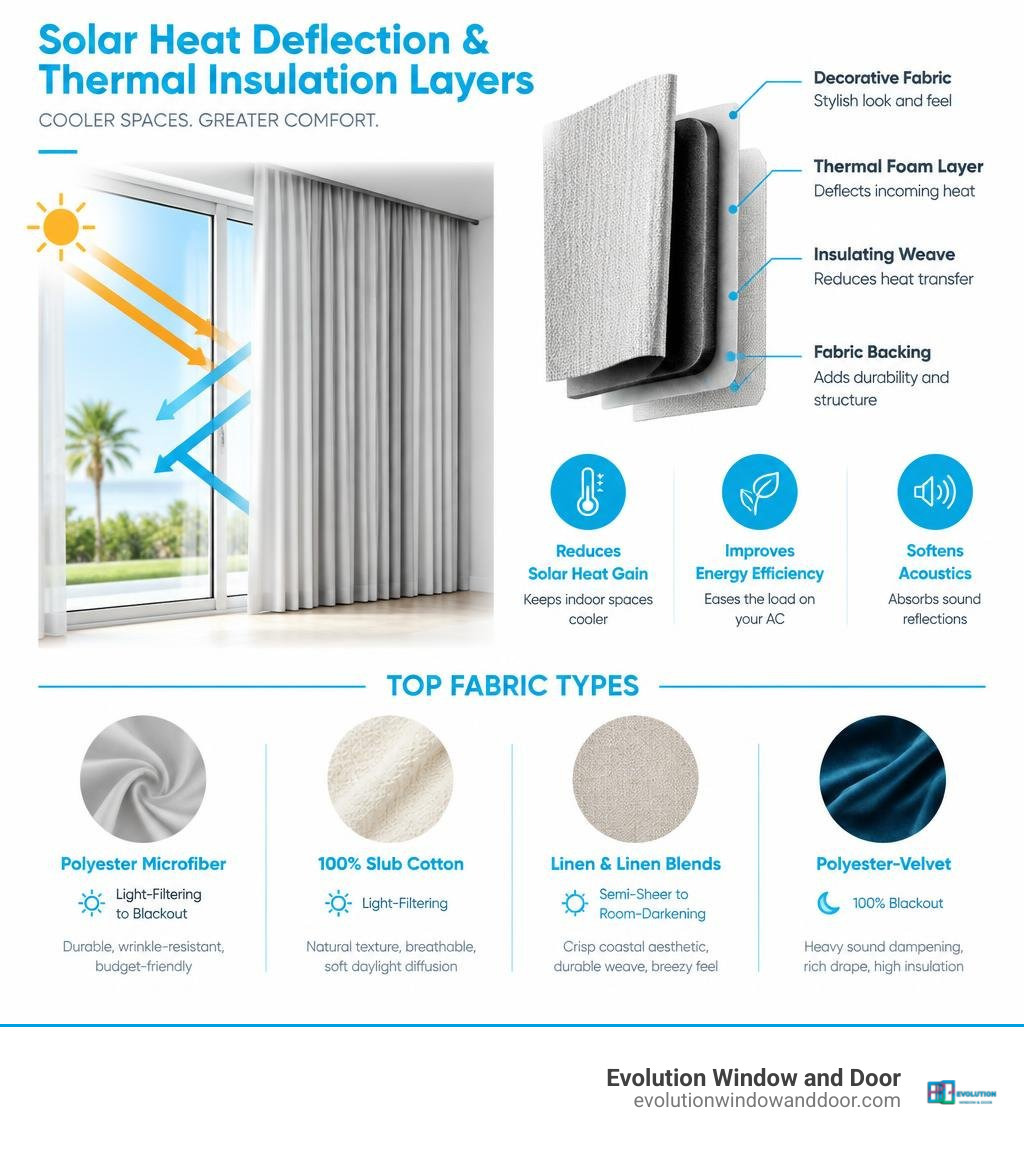
Thermal drapes can reduce solar heat gain through windows by up to 15% to 30%, which eases the load on your air conditioning system during peak summer afternoons. In addition to thermal benefits, dense multi-pass fabrics soften acoustics by absorbing sound reflections off hard tile and glass surfaces.
For large expanses like sliding glass entrances or French openings, pairing thermal drapery with impact-rated doors provides substantial protection against intense weather, humidity, and heat transfer.
Fabric Weaves, Slub Cotton, and Polyester Blends
The weave pattern of a curtain fabric dictates its visual weight:
- Slub-Weave Cotton: Utilizes yarns with slight variations in thickness, producing an earthy, textured look that softens direct glare without darkening the room completely.
- Polyester Microfiber: Features tightly woven synthetic threads that resist fading under strong ultraviolet exposure and maintain dimensional stability over years of use.
- Faux Linen & Voile: Delivers the open, breezy appearance of natural flax while leveraging synthetic durability to avoid stretching or sagging in humid environments.
Comparing the Best Styles of 54 x 84 Curtains
Curtains serve distinct aesthetic and practical functions depending on the level of light filtration you select for each room.
Blackout and Room-Darkening 54 x 84 Curtains
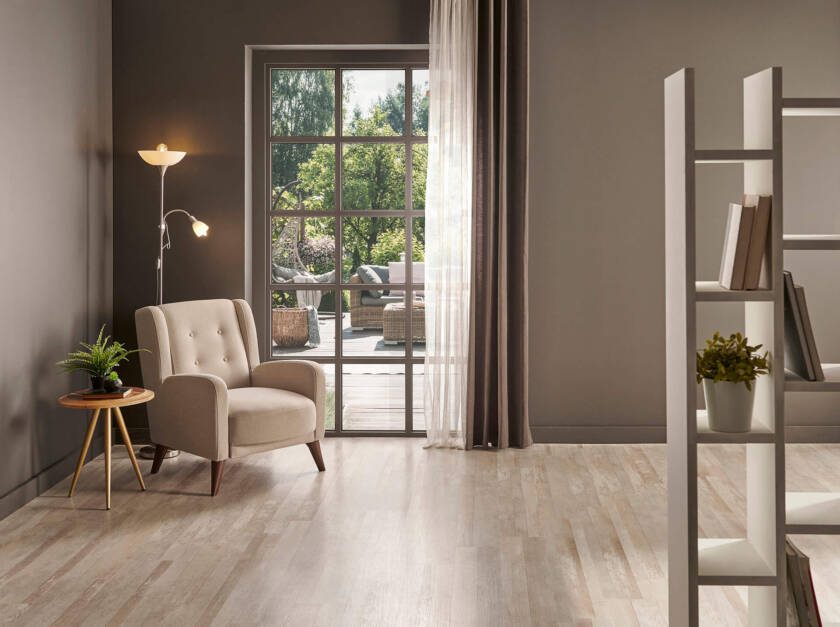
Room-darkening panels typically block 85% to 95% of incoming daylight, which helps reduce screen glare in home offices and media rooms. In contrast, 100% blackout panels feature an opaque backing or bonded multi-layer construction that halts all light transmission.
Blackout panels are particularly useful in:
- Bedrooms and Nurseries: Helping light sleepers and infants rest undisturbed by early morning sun.
- Home Theaters: Eliminating reflections on television and monitor screens.
- West-Facing Living Spaces: Blocking intense afternoon solar exposure.
Light-Filtering, Semi-Sheer, and Voile Drapery
Light-filtering and semi-sheer panels diffuse harsh sunlight into a warm, uniform glow while preserving daytime privacy. Unlined cottons, sheer voiles, and textured embroideries let natural light brighten living rooms and dining spaces without exposing the interior of your home to passersby. During evening hours, exterior visibility increases when indoor lights are switched on, which is why many homeowners layer sheer curtains beneath heavier blackout drapery on a double curtain rod.
Header Styles, Hardware Compatibility, and Hanging Methods
The header of a curtain determines how the fabric attaches to your hardware, how easily it slides open, and how the folds drape along the floor.
Grommet Tops vs. Rod Pockets and Back Tabs
Each curtain header style offers distinct functional and decorative benefits:
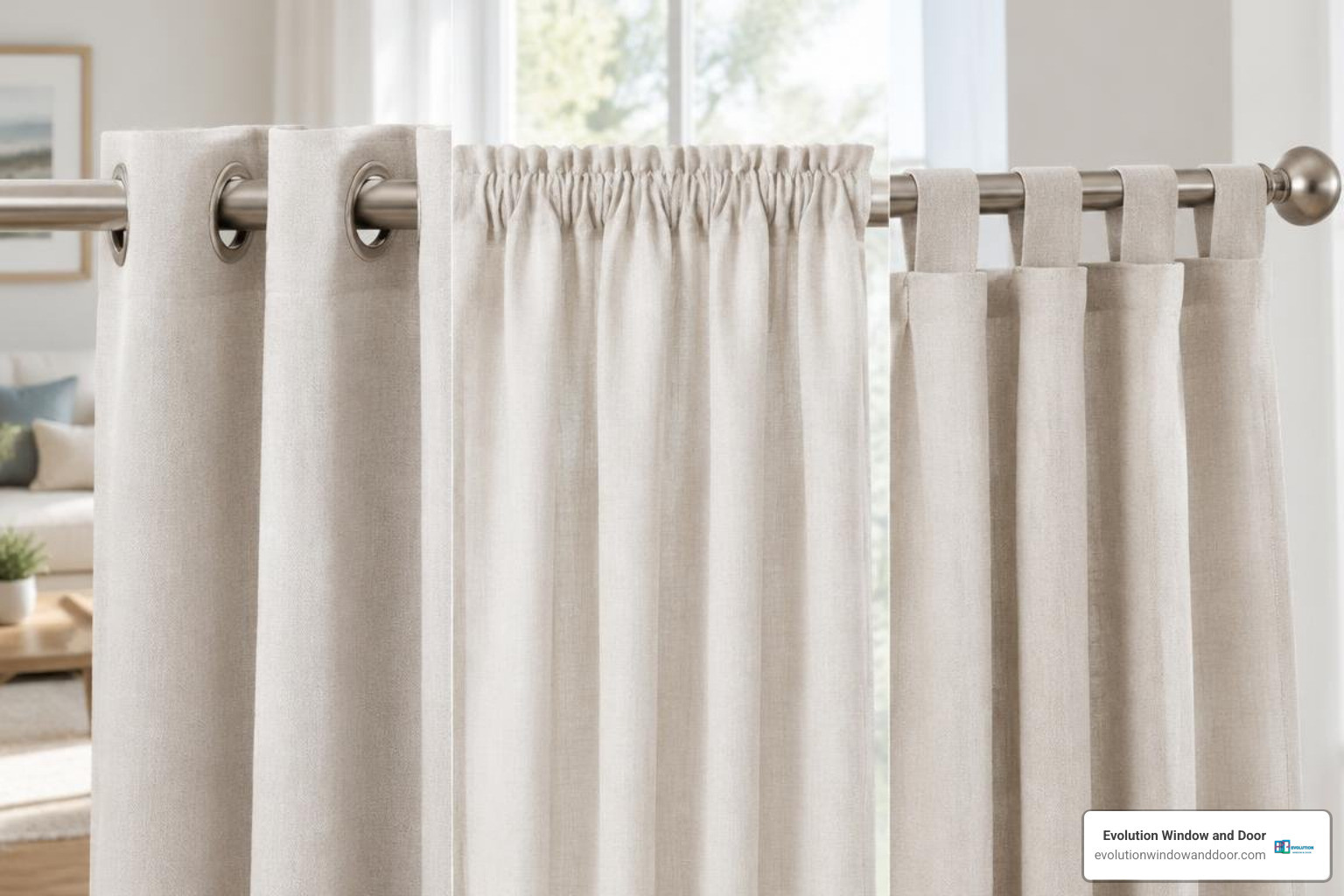
- Metal Grommets: Built-in rings at the top of the panel slide effortlessly along the rod, forming neat, uniform S-folds. Grommets are ideal for everyday curtains that you frequently open and close.
- Rod Pockets: Feature a sewn fabric tunnel (commonly 3 inches deep) that hides the curtain rod entirely. This style creates a gathered, traditional look but produces friction, making it best suited for stationary panels.
- Hidden Back Tabs: Provide the clean, tailored look of pleats from the front while concealing loops on the backside for the rod to pass through.
Rod Diameter, Brackets, and Installation Best Practices
Choosing compatible hardware prevents sagging and ensures your curtains operate smoothly:
- Verify Pole Diameter: Standard 1.65-inch grommets and 3-inch rod pockets fit poles up to 1.5 to 1.75 inches in diameter. Using an oversized rod will cause the fabric to bunch and stick.
- Mount High and Wide: Secure wall brackets 4 to 6 inches above the window frame and extend the rod 6 to 10 inches past the sides of the casing. This creates the illusion of larger windows and ensures the open panels rest against the wall rather than blocking the glass.
- Use Center Support Brackets: For spans wider than 60 inches, install a middle support bracket to distribute the weight of heavier blackout or velvet panels evenly.
Frequently Asked Questions About 84-Inch Drapes
Finding the right window treatments often comes down to precise measurements and proper maintenance. If you have broader questions about window construction, glass performance, or framing options, explore our comprehensive FAQs for detailed guidance.
How much window width does a 54×84 curtain panel cover?
A single 54-inch-wide curtain panel covers roughly 27 to 36 inches of window width when hung with standard fullness. A two-panel set totaling 108 inches of flat fabric is recommended to properly cover windows measuring up to 54 inches wide, ensuring the fabric retains attractive folds when drawn closed.
Can 54×84 curtains reduce energy bills and heat gain in sunny climates?
Yes. High-density blackout panels with thermal backings help block direct radiant energy from the sun. In sunny climates, keeping thermal drapes closed over sun-exposed windows during peak daylight hours can lower indoor room temperatures and reduce reliance on air conditioning.
How do I prevent cotton or microfiber curtains from shrinking when washed?
To prevent shrinkage and fabric damage:
- Wash panels in cold water on a delicate cycle using mild detergent.
- Avoid high-heat clothes dryers; instead, air-dry or line-dry the panels until damp.
- Use a handheld garment steamer or low-temperature iron to release packing wrinkles once the drapes are hung back on the rod.
Conclusion
Selecting the right 54 x 84 curtains transforms any living space by enhancing privacy, softening natural daylight, and boosting indoor comfort. By matching fabric density to the room’s lighting requirements and calculating proper two-panel fullness, you create a polished, functional window treatment. For long-term home efficiency, pairing quality curtains with precision-engineered windows and doors provides lasting performance and energy savings. Connect with Evolution Window & Door to explore expert guidance and custom solutions for your home.
